Be part of a global stargazing event

Try four simple stargazing challenges to win badges. Find star patterns and a planet in the night sky.

Come back and join us any time during the 100 Hours (1-4 October 2026) to complete challenges and add markers to your town or city on our UK & Ireland map.

Add to calendar

Stargazing through the Year

Why wait for October? Pop outside on any clear night and you can gaze across millions of miles of space with just the naked eye.

Check out our stargazing tips for beginners for some pointers on how to get started, including our favourite free stargazing apps.

And look below for some stargazing challenges for each season leading up to our next event.

Just remember, you don’t need to be an astronomy expert to enjoy the stars – they are there for all of us to find whatever joy, comfort or inspiration we choose.

Winter Stargazing

Orion the Hunter
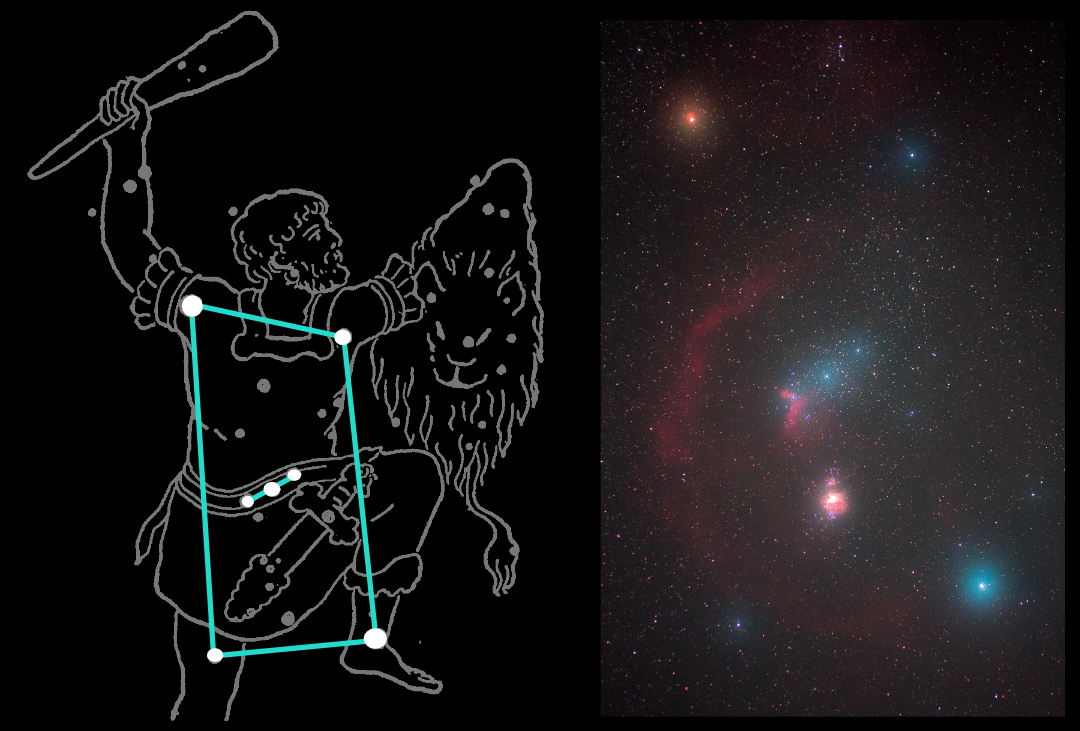
Orion is probably the best known of all the constellations. This pattern of stars can be seen in southern half of the evening sky from around Christmas-time through to April.

Look for a bright rectangle of stars with three stars crossing the middle. The big rectangle marks Orion’s body, and the three stars are his famous belt.

The top left star is called Betelgeuse, it is an old red star which will explode at the end of its life. This is expected to happen within the next 100,000 years. It probably won’t happen in our lifetimes, but it’s always fun to imagine witnessing this event! When it explodes, it will become so bright that it will be visible in the daytime.

Under Orion’s belt, you might see a fuzzy blob. This is the Orion Nebula, a vast cloud of gas and dust within which new stars are being born.

King of the planets
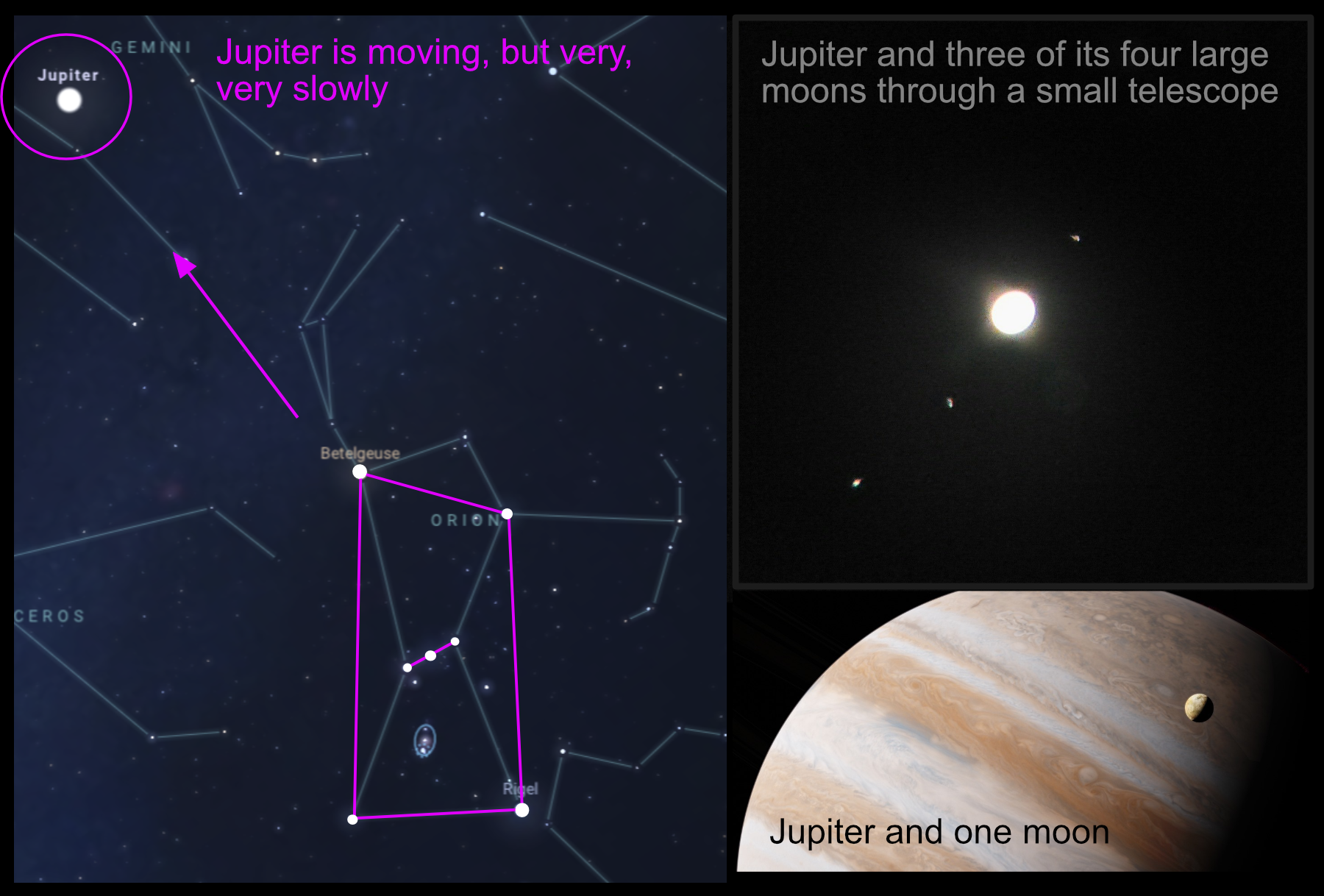
Look high above Orion and to the left. Can you see a very bright dot? This is the giant planet Jupiter. It looks just like a star, but it is reflecting sunlight rather than shining by itself.

If you have a good pair of binoculars (ones with wide ends are best), you might be able to spot one or more of Jupiter’s largest moons close to the planet. If you can spot them, draw where they are then look again another day to see how they move.
Spring Stargazing

Leo the Lion

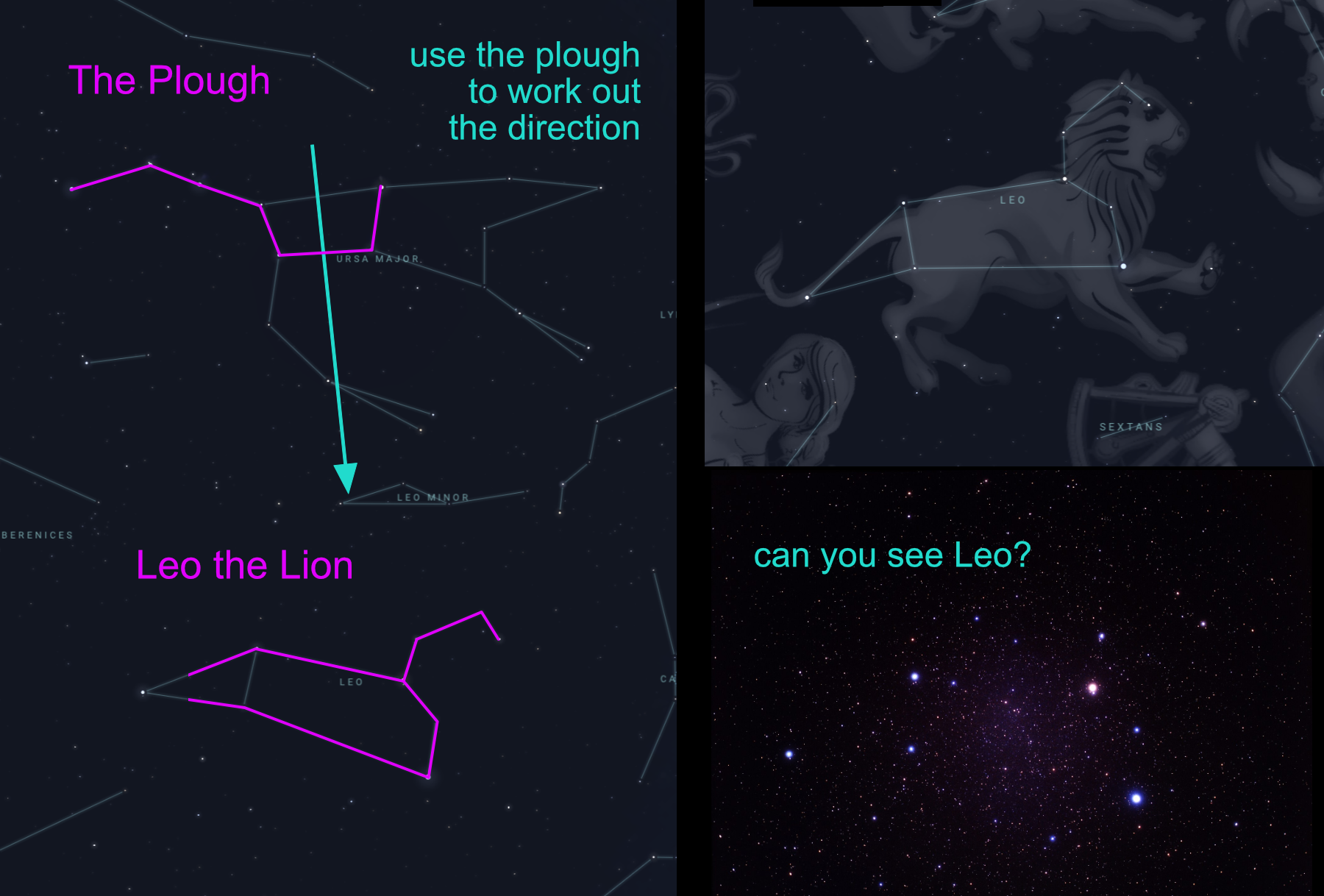
Leo is a very famous and easy-to-find star pattern (constellation) that can be seen throughout the spring and until early June. It will appear in the southern half of the sky, moving from east to west through the night. This movement is due to our view changing as the Earth spins us around. Leo’s position also changes from night to night as the Earth moves around the Sun in its orbit.

Start by looking for a backwards-question-mark shape with a bright star at the bottom. The whole constellation looks a bit like a bent coat hanger.

If you can still see Orion, then look further left to find Leo.

Another way to find it is to first find the saucepan-shaped Plough, and draw a line through its pan. I like to imagine the pan is full of baked beans and they are dripping through a hole in the base and landing in Leo’s mane.

Summer Stargazing

Lying out on a warm summer’s night looking up at the stars is always a magical experience.

However, the later sunsets make it more difficult to stargaze. And in June it doesn’t get properly dark at all (exactly how dark it gets will depend on how far north you are).

This said, by the end of the summer there will be some lovely dark nights again, and a special event that’s definitely worth planning a night out for:

Shooting stars (aka meteors)

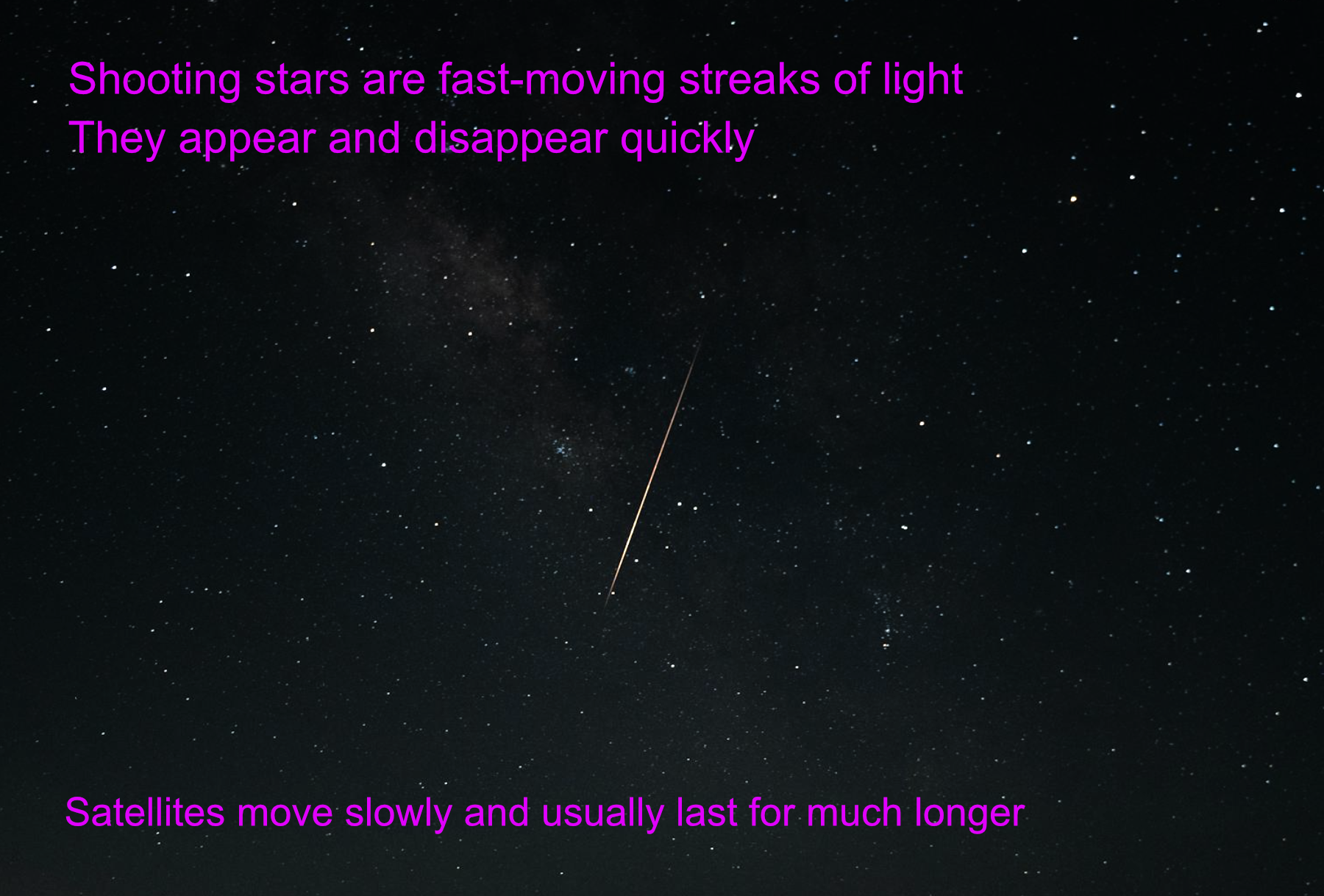
Shooting stars can happen at any time. They are caused by small pieces of dust speeding down through our atmosphere, creating streaks of light as they fall. They are easier to spot when the sky is really dark. Meteors move fast and shine briefly. If you see something that moves more slowly and steadily then that will be a satellite.

Wednesday 12 & Thursday 13 August are great nights to look for shooting stars, as the Earth will be moving through a bit of space where there is dust left behind by a comet. This regular shower is called the Perseids. This year is a great time to look out for them - there will be no Moon so it will be darker and easier to spot faint metors. See how many you can count. And don’t forget to make a wish!

Autumn Stargazing

Autumn is a wonderful time for stargazers as the nights get darker. It’s the perfect time to go stargazing before the winter cold sets in.

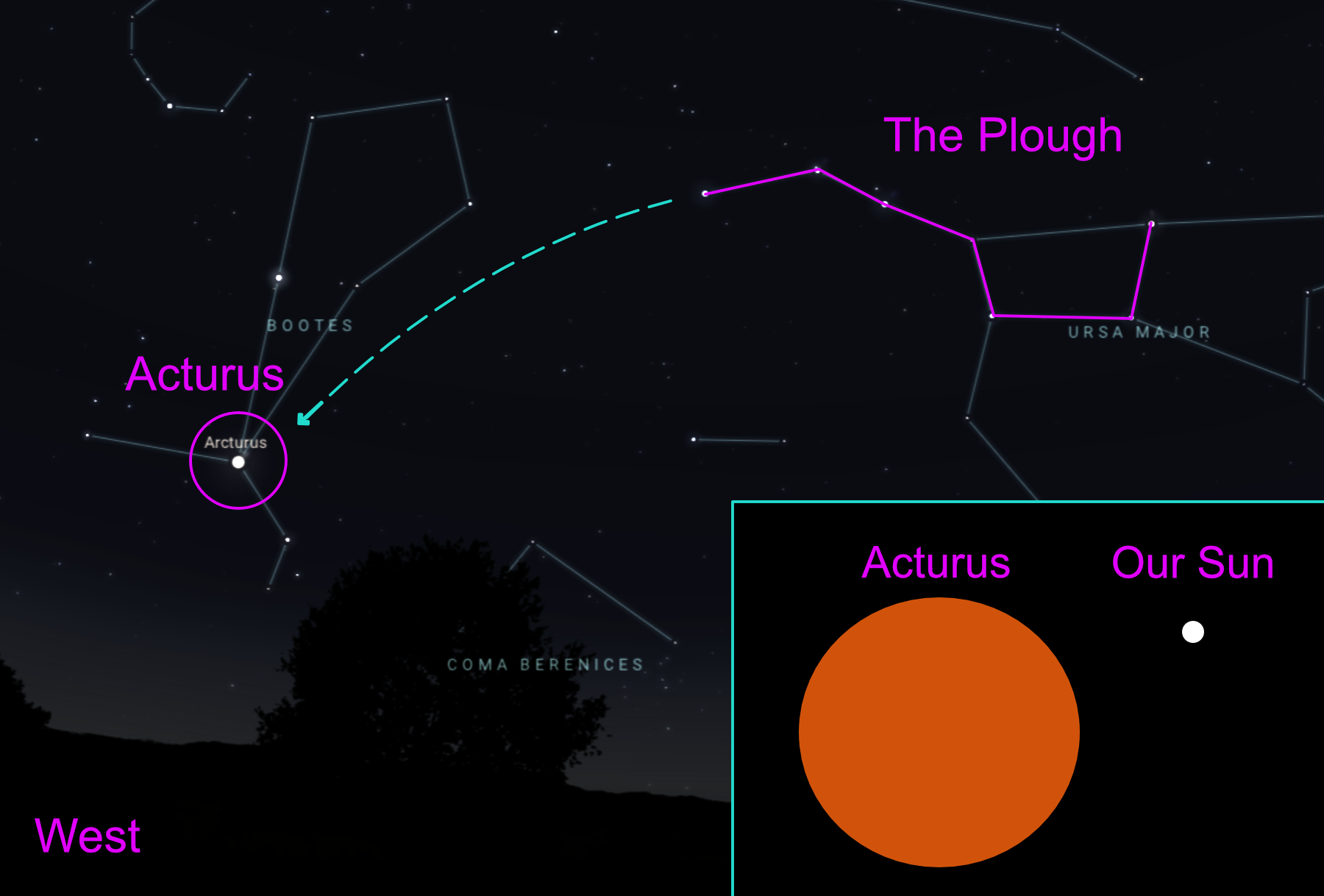
If you go out in September, see if you can spot the red star Arcturus before we lose sight of it for the winter. To do this, you will need a clear view down to the western horizon.

First find the Plough, then follow the curve of its handle down to find Arcturus.

Arcturus is an old star. It used to be similar to our Sun, but has swollen up in its old age and has cooled down, turning it red. Our Sun is currently about half-way through its lifespan and will swell up like Arcturus in a few billion years’ time.

Follow us on TikTok at @100Hours_stargazing or Instagram at @IAU_NOC_UK

We look forward to joining you Under One Sky, 1-4 October 2026!

100 Hours Under One Sky is a non-profit project led by the UK's International Astronomical Union (IAU)'s National Outreach Coordinator (NOC) team, with project partners Go Stargazing and the Republic of Ireland IAU NOC team. The project is funded by the IAU Office of Astronomy Outreach and the UK Federation of Astronomical Societies, and has also received support from the British Astronomical Association and Royal Astronomical Society. This project is part of the IAU's 100 Hours of Astronomy global event.